Best Toys for Senior Bull Terriers: Safe and Enjoyable Play for Aging Dogs
1. Teeth: Choose Chew Toys With Some Flexibility
Years of chewing, playing and exploring can take their toll on a dog’s teeth.
Bull Terriers that have spent years enthusiastically chewing toys may have accumulated considerable dental wear. Some may also have damaged teeth or gum sensitivity.
Good dog toy choices include:
- Flexible rubber toys designed for gentle chewers.
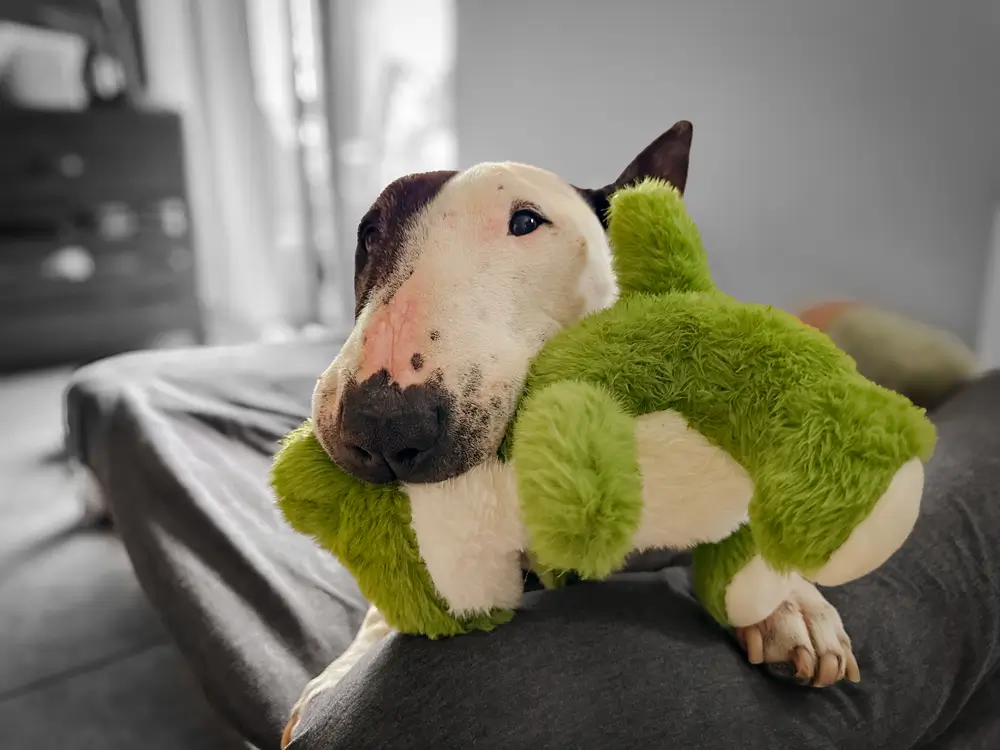
- Soft but reasonably durable plush toys.
- Appropriately sized food-stuffable rubber toys.
- Rope toys, provided your dog doesn’t shred and swallow the strands.
Avoid:
- Very hard nylon chew toys.
- Real bones, antlers and hooves.
- Excessively rigid or hard chews.
- Damaged toys with sharp edges or loose pieces.
A useful rule of thumb is to avoid dog toys that feel completely rigid and offer no flexibility. However, softness alone doesn’t guarantee safety. The material, construction and size all matter.
Don’t automatically trust a product simply because it is labeled as a senior dog toy. Check what it is actually made of and whether it suits your individual dog.
Also, watch for changes in chewing behavior. If your dog suddenly stops chewing, drops food, chews on one side or becomes reluctant to pick up toys, don’t automatically blame old age. Dental discomfort could be the reason, and a veterinary examination may be necessary.
2. Mobility: Make Toys Easy to Reach and Handle
Even muscular dogs such as Bull Terriers can develop arthritis, stiffness and reduced coordination as they age.
Vision and hearing changes may also influence how comfortably they interact with toys.
This doesn’t mean they no longer enjoy playing. They may simply need activities that don’t involve jumping, chasing or repeatedly getting up and down.
Look for:
- Lightweight balls that are easy to pick up.
- Soft toys that don’t require a strong grip.
- Toys that can be used while sitting or lying down.
- Food puzzles that don’t require excessive pawing or pushing.
- Toys that stay relatively close instead of rolling across the room.
A toy that constantly disappears under the furniture might be entertaining for a young dog but frustrating for an older one.
Pay particular attention to slippery surfaces such as tile and hardwood floors. A sudden turn or an attempt to chase a rolling toy can be uncomfortable or risky for a dog with mobility problems.
Sometimes simply rolling a ball across a non-slippery floor instead of throwing it can be enough to make playtime enjoyable again.
3. Mental Stimulation: Give the Brain Something to Do
Many Bull Terriers are curious, persistent dogs that enjoy investigating their surroundings. Even when their physical energy decreases, many still appreciate having something interesting to work on.
This is where enrichment toys become particularly useful.
Good options include:
- Simple puzzle toys that release treats.
- Snuffle mats for searching out hidden food.
- Easy-to-use treat dispensers.
- Nose-work activities that encourage sniffing and investigating.
- Food-stuffable toys that provide a longer-lasting activity.
Mental stimulation gives older dogs an opportunity to stay engaged without requiring extensive physical activity.
And never underestimate a dog’s nose! Even when the legs slow down, the desire to investigate interesting smells usually remains.
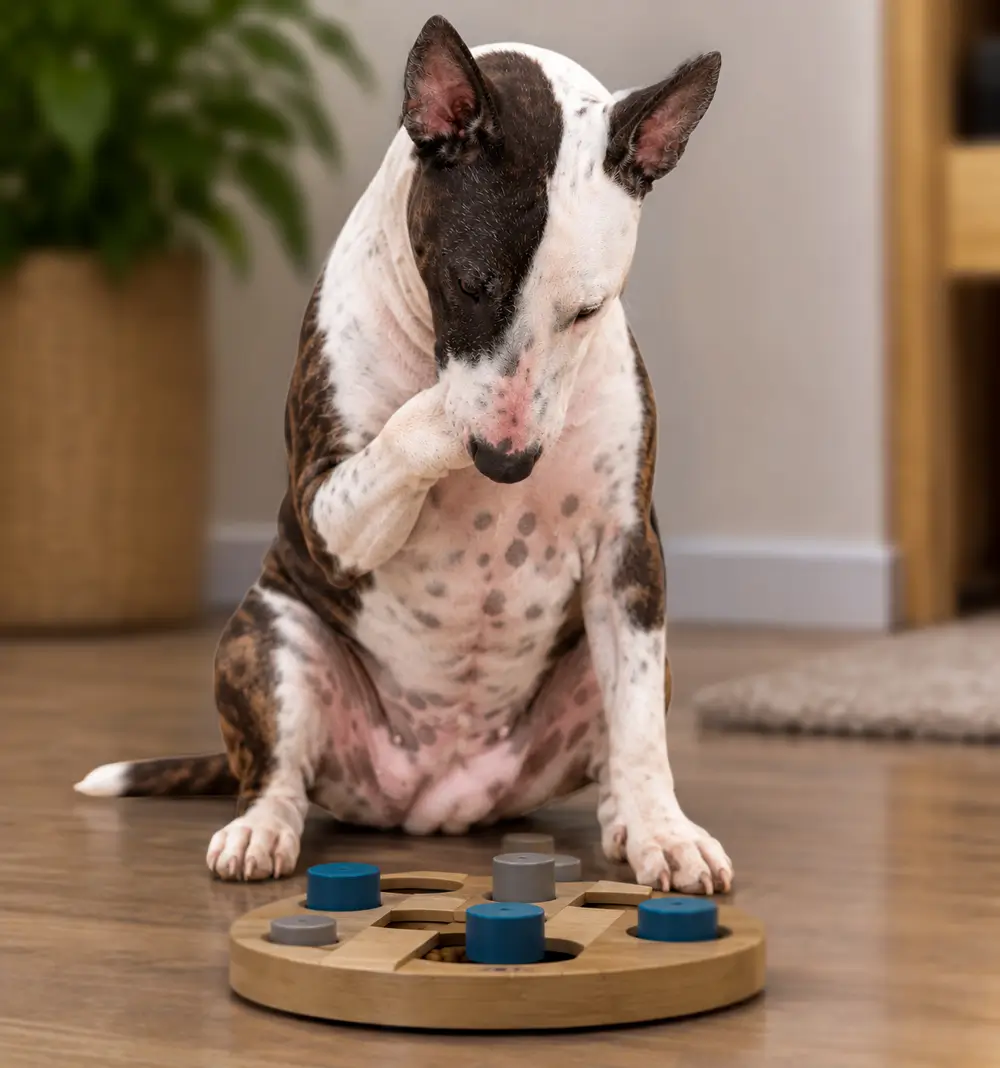
Start with simple puzzles. Your dog should be able to solve them without becoming frustrated or physically exhausted.
Mila still enjoys her snuffle mat and insists on having one regularly. It is a simple activity, but it gives her something interesting to do without putting unnecessary demands on her body.
4. Health and Diet: Match Toys to Your Dog’s Needs
Many senior dogs develop health conditions that influence which toys and activities are appropriate.
Heart problems, respiratory conditions, kidney disease, digestive sensitivities and special diets can all affect how you should approach playtime and enrichment.
For example:
- Prolonged excitement or strenuous activity may not be appropriate for dogs with certain heart or respiratory conditions.
- Fatty treats used in food dispensers may be unsuitable for dogs with a history of pancreatitis.
- Dogs on restricted diets may benefit from having their regular food used in puzzle toys instead of additional treats.
- Dogs with swallowing difficulties need toys that don’t release small pieces or require excessive chewing.
Before introducing a new activity, consider whether your dog has any dietary restrictions, physical limitations, dental problems or swallowing difficulties.
When necessary, ask your veterinarian which activities and toys are appropriate.
The goal is to provide enjoyable stimulation without accidentally working against your dog’s health needs.