Start the guide

Best Toys for Senior Bull Terriers: Safe and Enjoyable Play for Aging Dogs

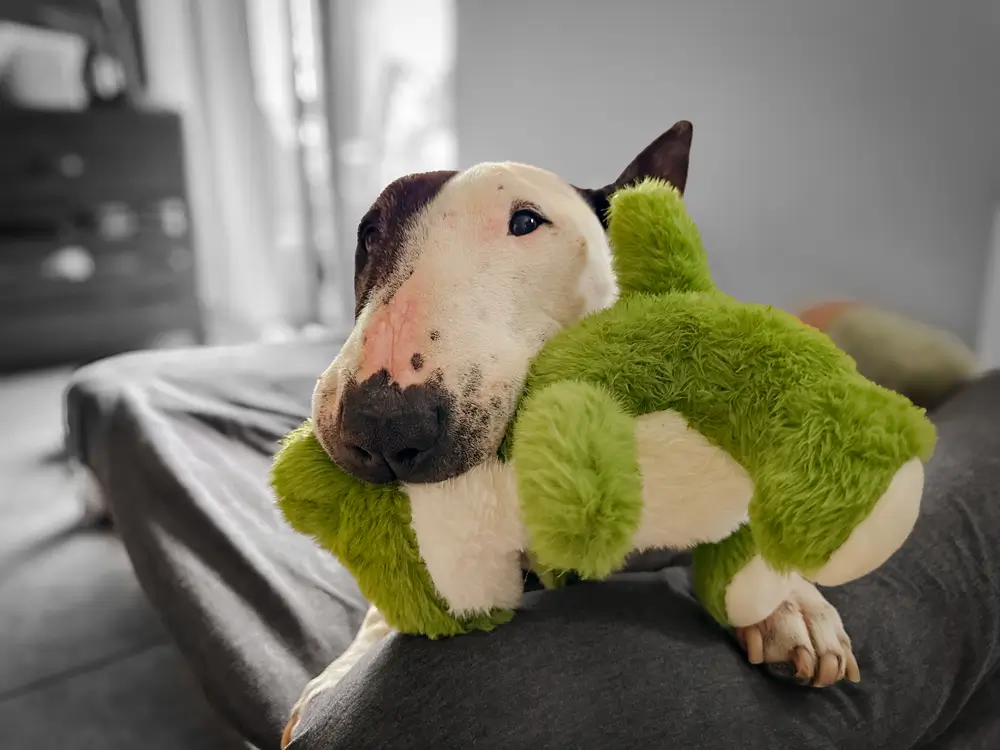
Bull Terrier Mila with a Plush Toy

How to Tell If a Toy Is No Longer Suitable?

Even a toy marketed specifically for older dogs may not be appropriate for your individual Bull Terrier.

Pay attention to how your dog interacts with it.

Warning signs include:

  • Repeatedly dropping the toy or struggling to pick it up.
  • Becoming reluctant to chew or carry it.
  • Pawing at the mouth or chewing differently than before.
  • Showing frustration instead of enjoyment.
  • Becoming unusually tired during play.
  • Developing cracks, sharp edges or loose pieces in the toy.
  • Missing toy components that may have been swallowed.

If you notice any of these signs, stop using the toy and reassess whether it is suitable.

Dental discomfort, sudden behavioral changes and suspected swallowing of toy pieces warrant veterinary attention.

Toy size matters, too. It should be large enough that your dog cannot accidentally swallow it, but not so large that it becomes difficult to hold or manipulate.

And remember: no toy is completely indestructible. Regular inspection and supervision remain important, especially with dogs that enjoy taking things apart.

Your Senior Bull Terrier Still Wants to Have Fun

Getting older doesn’t mean your Bull Terrier has to give up playing.

It simply means that playtime may need to look a little different.

You might replace the rock-hard chew toy with a flexible rubber one, swap energetic fetch sessions for a little nose work or discover that a simple snuffle mat provides more entertainment than an expensive new toy.

The same principles apply to senior dogs of every breed: notice their changing physical abilities, pay attention to their preferences and choose activities that offer enjoyment without unnecessary strain.

Sometimes all an older dog needs is a different toy, a little less action and someone willing to roll that ball across the floor instead of launching it into orbit.

Frequently Asked Questions About Toys for Senior Bull Terriers

What are the best toys for senior Bull Terriers?
The best toys senior Bull Terriers depend on your dog’s dental health, mobility and energy levels. Flexible rubber toys, plush toys, snuffle mats, easy food puzzles and lightweight balls are good options for many older Bull Terriers. Choose products that are comfortable to use and appropriate for any existing health conditions.
Should senior Bull Terriers still have chew toys?
Yes, provided the toys are suitable for their teeth and chewing abilities senior Bull Terriers might still have chew toys. Choose flexible rubber toys or other appropriately soft alternatives. Avoid very hard nylon toys, antlers, bones and hooves, which can cause dental fractures.
Are hard chew toys bad for older dogs?
Very hard chew toys can damage teeth at any age. Senior dogs may have additional dental wear, fractures or gum sensitivity, making appropriate toy selection particularly important.
What toys are good for senior dogs with arthritis?
Toys that are easy to reach, pick up and manipulate are generally preferable for senior dogs with arthritis. Snuffle mats, simple food puzzles, soft toys and lightweight balls can provide entertainment without requiring excessive jumping or running.
Are puzzle toys good for senior Bull Terriers?
Yes. Simple puzzle toys provide mental stimulation without requiring strenuous physical activity. Start with easy designs and make sure your dog can access the food without frustration or excessive effort.
Do senior dogs still enjoy plush toys?
Absolutely. Many older dogs continue to enjoy carrying, cuddling or gently shaking stuffed toys. Choose well-constructed products, inspect them regularly and supervise dogs that tend to swallow stuffing or squeakers.
Should I replace all my dog’s old toys when they become a senior?
You don’t necessarily need to replace all your dog’s toys when it ages. If your dog still enjoys a familiar toy and can use it comfortably and safely, there may be no reason to replace it. However, inspect older toys for damage, sharp edges, loose parts and materials that may be too hard for aging teeth.
How often should I replace my senior dog’s toys?
There is no fixed replacement schedule for your dog’s toys. Inspect toys regularly and replace them when they become damaged, develop sharp edges, lose pieces or can no longer be cleaned properly. Dogs that chew enthusiastically may need more frequent inspections.
Do these toy recommendations apply to other dog breeds?

Yes. Although this article focuses on toys for senior Bull Terriers, the recommendations apply to older dogs of all breeds. Individual dental health, mobility, chewing habits and medical conditions matter more than breed alone when choosing suitable toys.
Dorothea Cornelius

Written by

Dorothea Cornelius

More articles by Dorothea Cornelius →

Share your experience

For security, use of CloudFlare's Turnstile service is required which is subject to the CloudFlare Privacy Policy and Terms of Use.